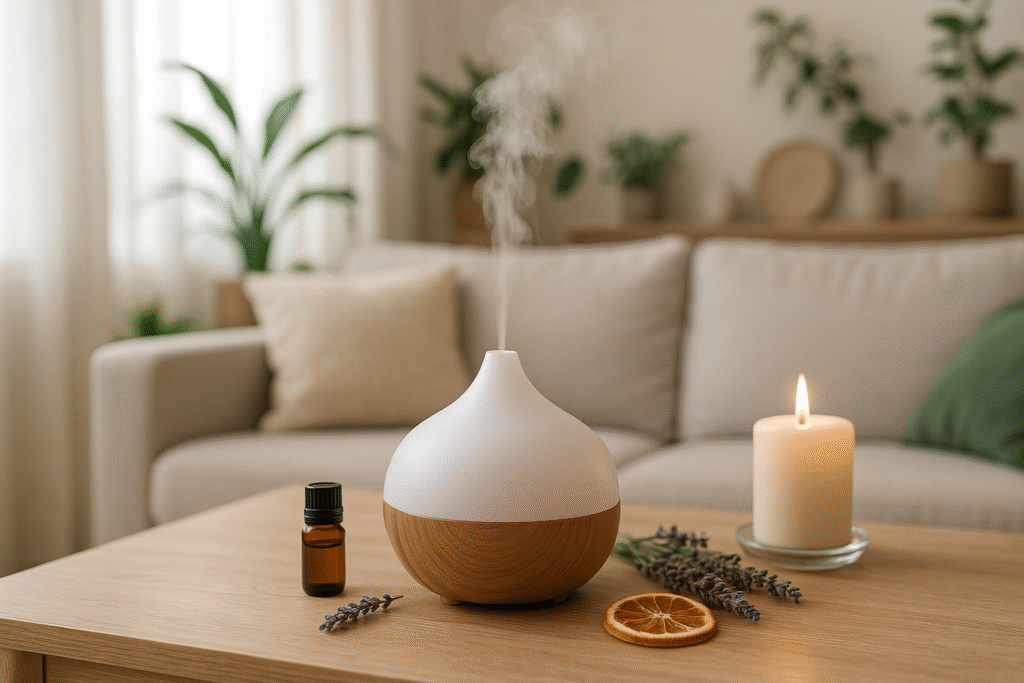
Have you ever turned on an essential oil diffuser hoping the atmosphere would truly change? Or found yourself confused among the many types and “aromatherapy” options, unsure which choice was right for you? The problem is that we often buy a diffuser without considering the type, the space, the quality of the oils… and then the result disappoints.
The outcome? Weak scents, a noisy device, an unpleasant smell, and no real sense of well-being.
But here’s the solution: this complete guide will help you understand what essential oil diffusers are, how to choose the right one for your home, how to use it effectively, and how to avoid common mistakes. You’ll find up-to-date tips, useful keywords to guide you, and practical advice to turn your environment into a true space of relaxation and improved air quality.
What Is an Essential Oil Diffuser and Why Use One
An essential oil diffuser is a device designed to disperse aromatic molecules from essential oils into the air, in order to scent the environment and—according to aromatherapy tradition—promote mental and physical well-being.
- Essential oils are highly concentrated extracts obtained from aromatic plants through methods such as steam distillation or cold pressing.
- Using a good diffuser makes it possible to turn a room into a more welcoming environment, promote relaxation or concentration, or simply eliminate unpleasant odors.
- It should be noted, however, that aromatherapy is not a clinically recognized medical treatment, but rather a complementary wellness practice.
Why Consider Using One
- Improves the atmosphere: thanks to the diffusion of natural fragrances.
- Potential support for well-being: oils such as lavender, orange, and eucalyptus are commonly used for relaxation, breathing, and mood support.
- Wide range of solutions: from reed diffusers to electric ultrasonic diffusers.
Types of Diffusers: Which One to Choose?
Not all diffusers are the same. Choosing the right type for your home and needs is essential to get the most benefit.
Reed Diffusers
These diffusers work without electricity: sticks are placed into a scented liquid containing essential oil, which slowly evaporates into the air.
Pros: elegant design, no noise, great as decor.
Cons: less intense fragrance, reduced “aromatherapy effect.”
Heat Diffusers – Essence Burners
They use a small flame or heat to evaporate the essential oil or blend. A classic example is the “oil burner.”
Pros: visual appeal (candle effect), simple to use.
Cons: risk of oil alteration (heat can degrade its properties) and higher maintenance.
Ultrasonic / Electric Diffusers
This is currently the most recommended type for those seeking a true aromatherapy experience. It uses high-frequency vibrations in water to create a fine mist that carries essential oils into the air.
Pros: more even fragrance diffusion, no heat that alters the oil, often equipped with timers, LED lights, and quiet modes.
Cons: require electricity and water, and can be more expensive.
Portable / USB Diffusers
Ideal for small spaces, cars, and travel.
Pros: versatile.
Cons: limited capacity and shorter runtime.
Factors to Consider When Choosing a Diffuser
- Room size: larger spaces require more powerful diffusers.
- Noise level: for bedrooms, ultra-quiet models are best.
- Timer and automatic shut-off modes.
- Ease of cleaning and maintenance.
- Quality of materials and safety (use of water or not, automatic shut-off).
- Design: if the diffuser also serves as a decorative element.
Guide to Proper Use of an Essential Oil Diffuser
Once you’ve chosen the right type, it’s important to know how to use it properly to get the most out of it.
PLACEMENT
- Place the diffuser on a stable, level surface.
- Avoid placing it near strong air currents or air-conditioning vents, as this can disperse the scent too quickly.
- For bedrooms: place it at least 1 meter away from where you sleep, to prevent the mist from reaching the pillow directly.
Dosage and Maintenance
- Follow the manufacturer’s instructions. As a general example, ultrasonic models typically require 5–10 drops for every 100 ml of water.
- Change the water regularly and clean the reservoir to prevent buildup and unpleasant odors.
- Use only pure essential oils or blends specifically recommended for diffusion; avoid unsuitable synthetic fragrances.
Usage Methods Based on Your Goal
- Relaxation and sleep: use oils such as lavender, chamomile, and ylang-ylang.
- Concentration, study, or work: lemon, mint, rosemary.
- Environmental purification or respiratory support: eucalyptus, tea tree.
- Atmosphere and home fragrance: citrus scents, vanilla, cinnamon (e.g., during the festive season).
Safety and Precautions
- Anche gli oli “naturali” non sono privi di rischi: irritazioni, sensibilizzazioni o cattiva qualità del prodotto.
- Do not leave the diffuser running in closed rooms without proper air circulation.
- Do not use it for too many consecutive hours unless specified by the manufacturer.
- If there are small children, pets, or people with respiratory sensitivities, choose gentler oils and usage modes.
Quality of Essential Oils and Device Maintenance
How to Recognize High-Quality Essential Oils
- Complete labeling: botanical name, part of the plant used, extraction method, place of origin, batch number, and expiration date.
- Prefer pure essential oils and, when applicable, those that are certified (organic, food grade, or suitable for diffusion).
- Store them in dark bottles, away from light and heat sources, to preserve their aromatic properties.
- Always check the intended use of the oil: cosmetic, environmental (ambient diffusion), or food use.
Important note: INCI ≠ quality!
An essential oil with an INCI has been registered as a cosmetic product, meaning it can also be used on the skin or for massages (always diluted).
An oil without an INCI, but with ingredients correctly listed on the label, has instead been notified to the ECHA (European Chemicals Agency) as an air freshener.
This type of product is not inferior in quality, but it is not intended for skin use or direct inhalation. It is designed for ambient diffusers and saunas, in full compliance with European regulations.
Diffuser Maintenance
- Regular cleaning: remove stagnant water and oil residues. Prevent mold formation.
- If it is an ultrasonic diffuser: empty and dry the reservoir, and preferably use demineralized water to prevent mineral buildup.
- Periodically check that the device is functioning properly (timer, automatic shut-off).
- If not used for a long period: clean it thoroughly and store it in a dry place.
Trends and Innovations in the World of Diffusers for 2025
In the wellness and home sector, essential oil diffusers are evolving toward greater technology and personalization.
- Smart features: app-based timers, remote control, and “aroma + chromotherapy” modes.
- Cold technology (ultrasonic) that better preserves the properties of essential oils.
- Designs that integrate the diffuser as a piece of home décor, no longer just an accessory.
- Combined sets: diffuser + essential oil blends selected for specific goals (relaxation, study, family).
Common Mistakes to Avoid
- Buying a diffuser that is too small for a large room → weak scent diffusion.
- Using too many oils together without knowledge → chaotic and potentially irritating mixes.
- Do not clean the device → unpleasant odors, reduced operation.
- Choosing “cheap” oils or blends without checking their quality → performance and safety risk.
- Ignore the air exchanger: even the best diffuser cannot compensate for a totally closed and poorly ventilated room.
Conclusion
You’ve seen how a well-chosen and properly used essential oil diffuser can truly transform your home, improving the atmosphere, promoting relaxation or concentration, and becoming a small investment in your daily well-being. We’ve explored what they are, the types available, how to use them correctly, how to choose quality oils, and what mistakes to avoid. The foundation is always forethought: it’s not enough to simply “buy it and turn it on.” It’s important to understand your personal needs, space, product quality, and use it wisely. This way, we solve the initial problem (confusion and ineffective purchase) and offer a solution (a step-by-step guide for choice and use). Now it’s your turn: choose, diffuse, and transform your space into an oasis of sensory well-being.
FAQ
How long should I leave an essential oil diffuser on?
Typically, 30–60 minutes is sufficient for an average-sized room; many models have an automatic timer.
Can I use any essential oil in the diffuser?
It’s best to choose oils designed for room diffusion; avoid synthetic fragrances and check that they’re suitable for use in diffusers.
What is the difference between ultrasonic and heat diffusers?
The ultrasonic model produces a cold nebulization and preserves the oil better; the heat model can alter the oil’s aroma and properties.
Is it safe to use the diffuser if there are children or pets in the house?
Yes, as long as you use delicate oils, ventilate the room well and do not leave the appliance on continuously without supervision.
Do I need to clean or replace anything in the diffuser?
Yes: empty the water regularly, clean the tank and make sure there are no oil residues or encrustations that could compromise diffusion or generate unpleasant odors.